

Essay Outside The World
What the Shade Is Called
Vocabulary is more than language. It is personal scripture.
I. Noise Without Language
This essay is about a painting. I framed the outline with that in mind. I had it nailed down. But at the end of it, I bet we will all agree the painting had nothing to do with it.
But before we take that journey, before the painting ever hung in my teenage bedroom, there were thoughts without language. Instinct without purpose. The OCD mind.
I want to properly set the stage and illustrate, as best I can, that my mind was already misfiring by the time I was five years old. I was a child driven by unnamed, invisible, relentless obsessions and compulsions.
The fears were real, heavy, and immediate. I lived in terror of unwanted change. Any manifestation of those things in the world around me would send my mind into an instant reaction. If I saw a sickness or an injury, my brain treated it like a contagion that was already rushing toward me. I had to seek immediate absolution, or else those exact things would happen to me too.
Every action I took was immediate compensation to ease the swelling anxiety. They were frantic, arguably silly attempts to make sense of a world where I lacked any understanding. That poor small five year old was terrified. Yet, my brain did not have a clinical vocabulary. It did not know the words for an anxiety disorder or an obsession. Instead, it spoke to me with a constant, paralyzing dread.
To survive the dread, OCD ritual became the only way to move forward. It was the language that dictated everything I did. But at times, it was a dark cloud over me. Why is my mom going to die if I do not take a step back with my left foot first? Why do I need to keep drinking water from this fountain when I am not even thirsty? There was no rational answer, but the voice inside my head insisted on the performance.
As I grew older, the unnamed OCD grew with me, adapting to every new stage and phase of my life. If there was a goal or a desire, that desire instantly found compulsion, and that told me the exact price it would cost to achieve it. It became a system of extortion. The voice dictated the ritualistic currency required to keep a girlfriend, to get the job, or to qualify for the home loan. And to a child...you want that new toy so badly? Fine, but here is what you have to pay the monster to get it.
I was running an exhausting loop long before I ever introduced the disease to the complexities of adulthood.
I remember the day I discovered these obsessions could have painful results. I was five years old, tarrying at Oak Hills Elementary while my mother worked her shift outside on ground duty. I was wandering the corridors, a tiny human discovering their way in safe halls, when I found my way into the school lunchroom. The space was bustling, loud and chaotic, as the cafeteria women worked to prepare the final meal of the day.
My brain fastened onto one of the women, someone who had until recently been so kind to me. The loop took over. I wanted her attention. I kept bugging her, stepping into her orbit, persisting over and over because my mind simply would not let go.
She repeatedly told me to go away and find my mom. They were in the middle of dangerous work. But the compulsion inside me was an absolute mandate, and I could not stop. I tapped her on the back over and over again.
Then came the pain. The blow landed entirely out of nowhere, shattering the noise of the kitchen. The woman had turned and backhanded me so hard that the force of it sent me staggering backward. My head slammed into a gigantic industrial food machine.
I did not cry. I was too shocked for tears. I turned and ran, escaping that kitchen with an ache in my skull and the realization that the world outside my head could be just as violent as the thoughts within it.
That was the terrain of my mind before the religious architecture was ever built around it.
II. The Attack Vector
Until I was eleven, church was a family event. I remember my mother being brave enough to speak in sacrament meeting. I remember my father singing How Great Thou Art. I remember feeling pretty good about the state of things.
Then, in 1990, we moved to Arizona, and the family scattered. Adam was on a mission in Bogotá. Tyler was at Ricks College. Heather refused the move and went back to our grandparents in Bountiful. I was the only child who made the trip, one boy receiving all the current from two parents who loved each other but loved to fight even more. They lost their Utah friends in the move and never really replaced them. I cannot reconstruct everything fully anymore. Maybe they both still went when I was eleven or twelve. Then it was just my mother. Then it was just me. Someone drove me; I think it was them. I wore a white shirt and tie because everyone else wore one, and I drifted the hallways after sacrament meeting because my mind could not sit still in a classroom. Nobody explained the doctrine to the boy in the hallway. I learned the dress code by sight and the rules by accident, and my rituals rode along with me the whole way, growing up as I did.
We usually see the weight of heavy moments through the precious gift of hindsight. That can cloud memories, or make them sharper. But looking back can also be a strange mixture of confusion and clarity, because in reality, the day the painting arrived in my life was quick, bright, and pain-free. There was no heavy, dramatic exposition. My mother simply walked in and handed me a widescreen print. There was no explanation, no lecture, and no maternal testimony.
I never asked her what she knew about the picture itself, or why she gave it to me. It is likely that a church leader, a ward member, or perhaps my grandparents who were preparing for a mission to New Zealand had suggested it to her. She was just a mother who loved her youngest son. And feared greatly for him, too.
I was the only one of my brothers and sisters being raised outside the influence of Utah's impeccably clean Mormon culture, trying to find my way in an Arizona public school system that felt completely foreign to her. While she did not feel she could hack going to church herself, she saw the desirable social results of clean living. I do know she wanted that safety for me. She wanted a clean-cut, obedient, charming young man. Maybe handing me that print was simply one of the ways to get what she wanted.
It felt light in the moment. But my mind was already vulnerable, and that picture was the strongest attack vector imaginable, though I did not know it yet.
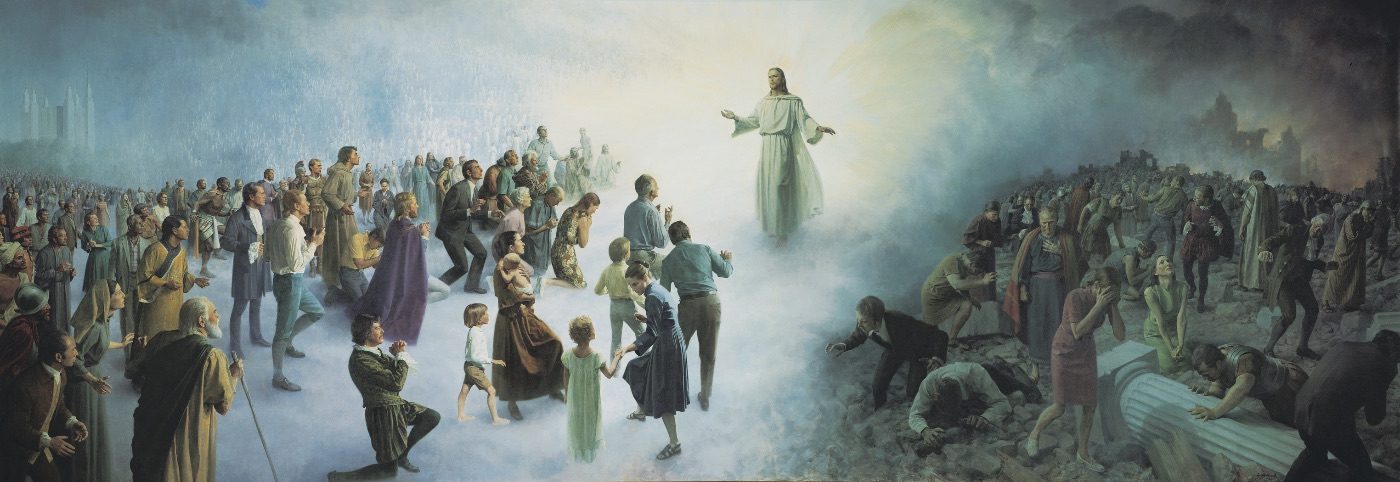
If you grew up in or around the church in the eighties and nineties, you know the image by heart even if you do not know the artist, John Scott, or the title, The Last Judgment. The original is a mural, twelve feet tall and twenty-seven feet wide, painted in 1974 for the entryway of the Washington D.C. Temple. The widescreen prints went everywhere after that. The composition holds an entire cosmic scene in a single glance. In the center, Jesus Christ descends through a tear in the sky, bathed in a bright, vertical shaft of light.
To his right, the righteous are gathered in clean, bright supplication. Their faces are turned upward in a unified attitude of singing and praising him. It is a scene of perfect, orderly safety.
But it was the left side of the canvas that caught my gaze and held it hostage. There, the world is in chaos. Worldly structures and massive government buildings, including a prominent capitol dome, are toppling down in ruins. Dust and destruction are everywhere. The crowd on this side is caught in total, weeping finality, wailing and shielding their eyes from the blinding light of the center.
I hung that widescreen canvas above my bed. I stared at it, fascinated by the people on the left side of Jesus, invariably finding myself among them. I became hyperfixated on two specific figures. There was a woman kneeling in the dust, praying desperately to God for a deliverance that was clearly too late. Unnamed emotions welled up inside me as I put myself in her shoes.
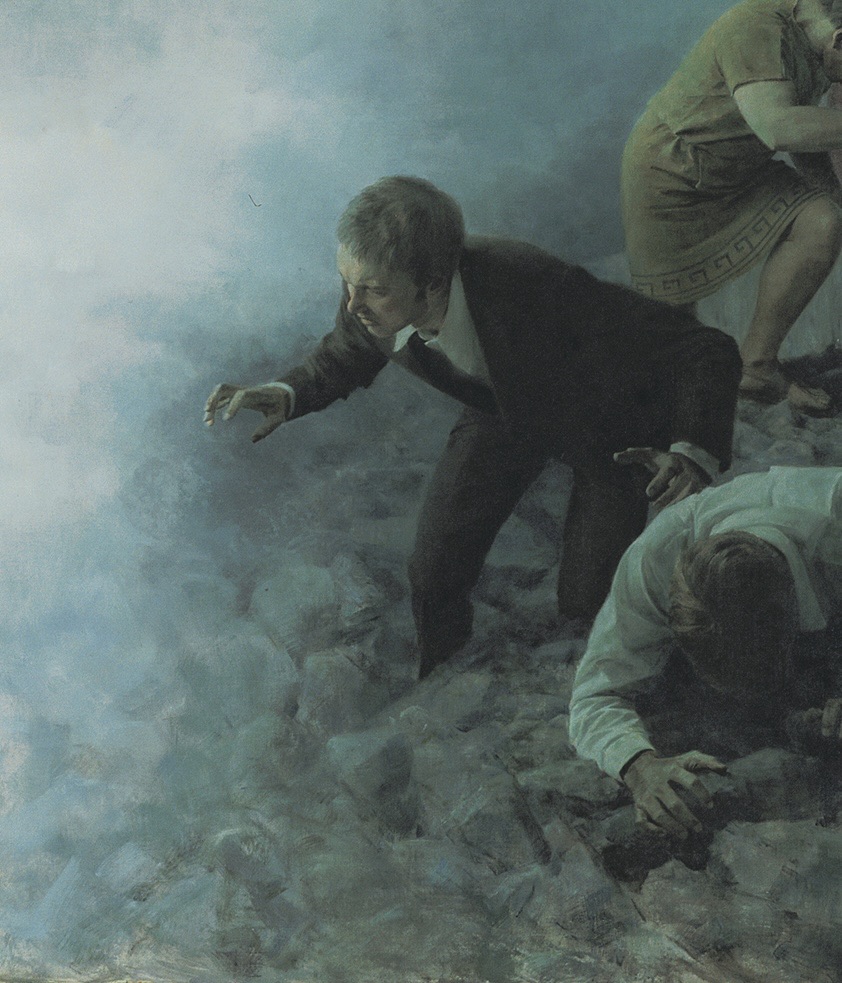
And right at the edge of the crowd, standing immediately next to the bright shaft of light, was a man peering through the invisible veil of separation. His left hand brushes the back of a fallen man, and his right hand stretches toward the light, inches away.
I spent hours looking at that man. I made up stories about him in my head. His narrative was unpleasant. I wondered if the judgment was a scorecard, and he had ended up with a fifty-nine percent. He was so close to the right side. But he failed. He was certainly cast aside and left out.
My regular, everyday OCD looked at that dividing line, looked at that man standing a fraction of a percent away from safety, and found the ultimate, official rulebook for the nameless terror I had been carrying since I was five years old. It was almost as if the monster that resided within me was given the exact fuel it needed to erupt in massive flame.
It did not matter that the rulebook of OCD itself still had no name.
III. The Split and the Voices
When that painting went up over my bed, I was living a split life. At school, I had a crowd of friends I cussed around, and I got into fights often enough to get suspended. At church, I had another group of friends I tried to fit in with, desperately attempting to look like the clean-cut kid everyone expected.

It was hypocrisy, and I knew it even then. But I cannot emphasize enough that I did not know who I was at that age. I had very, very low self-esteem. I could not see myself as smart, attractive, or charismatic, even though I wanted to be all of those things. And like most teenagers, I just wanted acceptance. I wanted to be around girls. I wanted to be good at sports. I just wanted to belong somewhere, anywhere, whether it was with the good crowd or the bad.
Church, at that point in my life, was church in name only. It was not a place for spirituality, or learning, or personal growth. It was simply a place where I either felt bad about myself, or I felt bad about other people. Mostly, I felt bad about my parents. Feeling my way through a high-demand religion in the dark meant that my innocence was constantly being chipped away by dogmas and doctrines I did not fully understand, and I had no life preserver to keep me afloat when the lessons got heavy, in part because I played the part of faithful conviction like a pro.
And then, there was the jarring shame of accidental discovery. I only learned about the Word of Wisdom when an active LDS friend came over, saw the tea brewing outside by our pool, and told me matter-of-factly that my mother was a sinner for drinking it. I only found out about temple garments when I slept over at a friend's house and saw his parents walking around in them.
So into this environment of unease and duality came the painting in question. It took my fragile, split existence and turned up the volume to 11.
What happened next has a name, though nobody handed it to me for decades. Handed to the right person at the right hour, a name is a rescue, so let me hand you this one now, on time: scrupulosity. It is what obsessive-compulsive disorder becomes when it finds religion. The disease does not fight faith. It converts. It learns the doctrine, memorizes the commandments, and the same extortion that had been bargaining with me as a child started charging me for salvation.
The childhood rituals became more intense, more focused, and explicitly named. They referenced darker fears and desires than I could have ever imagined on my own. My OCD developed different voices that paraded within the folds of my own mind. One voice was God, though He was always the quieter of the two. The other was the devil, or Satan, or whatever dark shape my mind could concoct.
And the "devil's voice"? It turned my life into a series of daily, ritualistic negotiations over my own happiness and damn near halted all progression. Do this, and get the girl. Don't do this; if you do, I will take away that relationship you just got. The worst moments were when my mind made any connection between cause and effect, so the whisperings would become even more haunting. Remember when you lost that basketball game? I'll make you lose again, and again, and again.
My days became ritual payments to a voice I did not understand. At best, I was torturing myself. At worst, God was being entirely drowned out by the machinations of a devil who was living inside my own head, threatening to destroy my life at every single turn. Any moment of genuine happiness curdled into angst. Any agonizing observance of completed compulsion became an anointing of the only balm of Gilead I had: the washing of my soul with ritual performances that made sense only to the demons in my mind.
The painting did not just stay on the drywall. It crawled down from the frame and mapped itself directly onto my bones, burning the right into me in a desperate, physical way. My right hand, my right arm, and my right foot became the instruments of my salvation. The entire right side of my body was the portal to penance. I became absolutely obsessed with left and right directions, and their corollary even and odd numbers.
Crossing a threshold or walking through a doorway meant finishing precisely on the right foot, or shrugging my body that way. It was somehow a silent, rhythmic prayer in order to be counted among the singing crowd in the white robes. Looking back now, I can see the beautiful, innocent light hiding underneath all that madness. I desperately wanted to be clean. I wanted to be whole. I was using my own small body as a literal anchor, trying to drag myself across the divide into a safe harbor.
But a binary system is a fragile thing to house inside a human chest. When your definition of safety is that perfect and that rigid, normal human life can feel like a catastrophic failure. I would hyper fixate on choices, both good and bad, and the relevant rituals and payments that would be required in the future to repeat them, or stave them off. And the consequences went from temporal to eternal almost every time.
This internal warfare left me terribly alone. Whenever a grown-up or a church leader would praise me for acting well in a calling or bearing a testimony, I felt like an absolute fraud. The outside world was validating a saint, but my scrupulosity told me I was hosting a monster. Praise did not feel good. It triggered a brutal internal audit, a sudden spiral into how terrible I actually was.
The universal mantra of my mind became a quiet, terrified whisper: If they only knew.
IV. The Backpacker and the Loophole
When you are drowning in that kind of internal shame, you become a scavenger for relief. In church, they taught us the lesson of the backpack filled with stones. It was a standard, well-intentioned lesson meant to show how sin weighs a person down, and how the process of confession and repentance lightens the load. But to an OCD brain, that metaphor is a death sentence. Because my mind was a factory that constantly generated involuntary, intrusive thoughts, I knew with absolute certainty that the game was rigged. If I went to the bishop's office and emptied the backpack, a brand new stone would drop right back into it before I even made it out to the parking lot. I felt that the backpack was completely unavoidable. I was destined to fill and refill it forever. The fatalism of it was exhausting.
I started scrambling through the scriptures, looking for a way to bypass the human system entirely. I remember reading the Book of Mormon, completely fixated on the story of Enos. He was a man who went into the wilderness and prayed so fervently, wrestling before God all day and into the night, that a voice finally came to him and told him his sins were forgiven because of his faith.
To my fourteen-year-old mind, that was not just a scriptural account. It was a loophole. It was a survival instinct. If I could just pray hard enough in the private wilderness of my bedroom, God Himself would forgive me for all the terrible things my brain was thinking. He would release me from my bonds of ritualistic torture. I did not want to talk to anyone human. Human contact meant exposure, judgment, and the terrifying threat of losing the obedient persona my mother needed me to have. Talking to a person meant shame.
Later, teachers would try to correct me by saying that shame was just another tool of the devil, and that repentance was actually beautiful, loving, and amazing. But there was an edge to that teaching that they never understood. I had already given 'the devil' too many tools freely.
When anyone in authority tells you that a natural human emotion is from the devil, a scrupulous brain does not just learn to avoid the feeling. It begins to see the devil inside all the quiet irregularities and malfunctions of its own biology. If the shame and the anxiety I felt were demonic, then my malfunctioning brain was no longer just sick. It was a playground for the adversary. Every chemical misfire became a spiritual failure, a sign that the enemy had taken root inside my head. I could not reconcile a beautiful, loving repentance with a mind that felt permanently occupied by the devil himself. I still have a hard time reconciling that today.
I carried those secret, bleeding wounds all the way into my twenties. The best example I can describe revolves around the natural way we interact with traditions as we grow up.
As we age, the bright, high-contrast emotional magic of childhood holidays naturally begins to soften. It happens to everyone. The ambient wonder of Christmas shifts into a quieter, more nostalgic adult experience. But a scrupulous mind cannot tolerate a neutral, biological shift. Because my brain had been trained by the painting on my wall to see everything in terms of the saved right or the damned left, it took that normal loss of holiday magic and read it as evidence. It told me that the emotional flatness was not a part of growing up. It was the literal withdrawal of the Holy Ghost. I assumed I was going numb because I was rotting from years and years of unrepented sin and allowing the voices in my head to win, dating back to before I had even gotten married.
One Sunday morning, just before Christmas, the torture inside my head became too loud to bear. I all but ran to the bishop's office. When I sat down across from him, I did not confess a list of crimes or actions. I just broke. I looked at him and said, Help me enjoy the upcoming Christmas season and forgive me.
I was asking a human judge to grant me permission to feel joy again, because the judge inside my own head had locked me in the dark.
My bishop was a dear, loving man. He did not castigate me. He did not look at me with anger. He just looked at me with pity. He did not see a rebellious sinner needing a formal repentance plan. He saw a young man crushed under an invisible, exhausting weight. He tried to offer pastoral warmth, telling me that whatever price was required had obviously already been paid by the immense guilt I had placed upon the circumstance.
But there are deep limitations to a lay-clerical system. My bishop was not a trained mental health professional; he was a neighbor doing his best to minister with the only tools the institution had given him. And when those standard tools are applied to a clinical psychiatric condition, they can accidentally become instruments of damnation.
As he tried to comfort me, he said, I always felt there was something holding you back. To him, it was a phrase of brotherly love. He was trying to say that he saw my potential and wanted to see me shine. But to my scrupulous brain, it was another stroke of condemnation. It was a confirmation of my absolute worst nightmare. My OCD had been whispering for decades that I was a rot-filled fraud, and now the literal judge in Israel was confirming it. He could see it. My mask had not worked. The rot was visible.
The irony was that the thing holding me back was not a hidden sin at all. It was the scrupulosity itself. I was being held back by the very system of repentance I kept running to for rescue. No one in that room was a villain, yet real psychological damage was being done in that office all the same. And the most bitter part of that memory? I did actually find relief from the compulsive action to run to the bishop. The payoff came as promised. Yes, by then I had language for what was happening to me. I had carried it for years. But the knowing did not stop the running.
It is a memory that remains, unfortunately, tinged with blood.
V. The Language of the Low Spot
I can still attest through all of this that God does, in fact, listen to the longings of our hearts. Verbally or otherwise, my soul must have begged for relief. I thought I knew what relief would look like, too.
But change does not always come from a dramatic, frontal assault on our problems. Sometimes it happens the way water finds its course, quietly tracing the path of least resistance, seeping through the smallest structural cracks until it pools into a mirror. But after years of suffering under the delusion of ritualistic cause and effect, I was bloodied into not looking for an answer. I had long since accepted the hostage situation in my head as my permanent reality, a legalistic contract written in a language I could not translate.
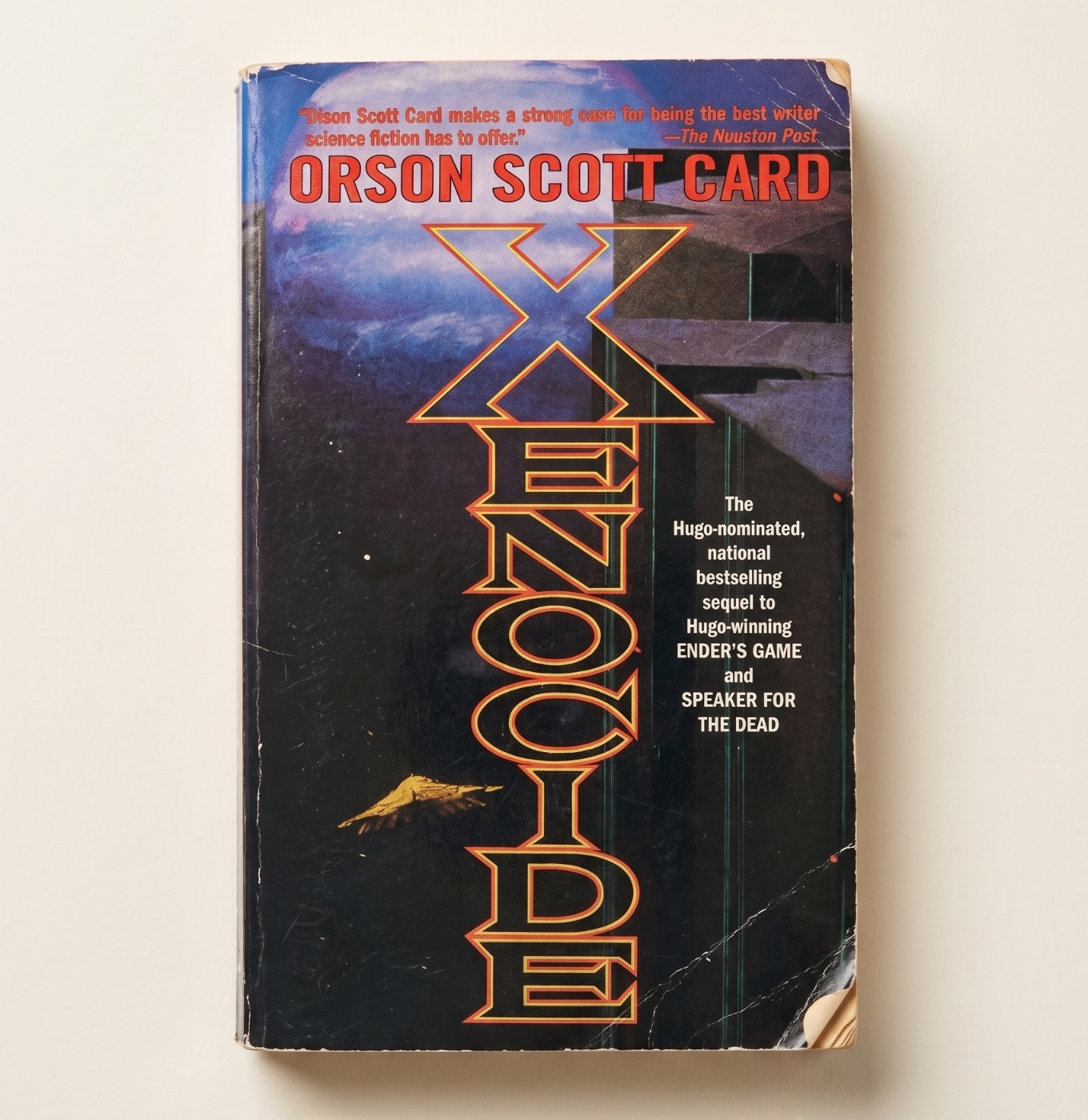
But when I was eighteen, preparing to serve a full-time mission for the church, a lifeline appeared from a most unexpected place. Be it God or circumstance, I found language within the pages of Orson Scott Card's science fiction novel, Xenocide.
In the book, there is a population of people who believe they are uniquely holy, chosen to hear the direct whispers of the gods. The cost of this holiness is an agonizing, repetitive series of physical rituals. They are driven by an absolute internal need to trace the grain of wood on the floorboards or wash their hands until their skin bleeds, convinced that if they stop, the universe will fall apart. Any attempt to resist the compulsions brought an immediate, suffocating escalation of internal anxiety. The psychological torment would build to such a punishing, unbearable degree that obedience became the only way to find breath.
The true perversity of that culture lay in how deeply coveted this torment had become. To be named "godspoken" was the ultimate social and spiritual currency. Adults would watch their own children with an anxious, almost predatory vigilance, desperate to catch the first glimpses of a glitch. They wanted to see the frantic tracing or the obsessive handwashing because they mistook a child's silent imprisonment for a crown of sanctity. The very sights that should have broken a parent's heart were instead celebrated as a badge of election.
Then the truth comes out, and it is grotesque. It is not a spiritual gift. The ruling Starways Congress had genetically engineered this extreme obsessive-compulsive disorder as a weapon of absolute compliance. The people of Path were simply too brilliant to govern, so the authorities built a clinical cage inside their DNA to keep them docile, manageable, and trapped entirely inside their own heads.
That was the thing that hit me first: the control. The "gods" ruling over my own mind were not cosmic or divine. They were an outside authority that had weaponized my vulnerability to keep me compliant. My brain had been occupied by a system of expectations and institutional fear, a story designed to dictate my every step and score my every thought. I was not serving a loving creator in those moments of torture. I was obeying false and empty promises entirely conceived by a tired mind.
Reading those pages cut straight through the noise. For thirteen years, my brain had been generating a frantic, nameless terror, and suddenly a mass-market paperback was holding up a mirror to my exact circumstances. It was the first time I realized that the whispered torturings were not the devil, and they were not the voice of an angry God auditing my worthiness.
It was a disease. It was OCD.
The book gave me a vocabulary. It did not cure the illness, but it gave me a bit of focus to finally confront the challenge. It gave me the clay to start building meaning out of the meaninglessness.
I eventually took that new language to my mother. I thought she would be relieved to know there was a name for the weight I was carrying. Instead, the denial was visceral.
The moment the words left my mouth, she literally turned her whole body away from me. Her reaction was so sudden it looked like she wanted to put her fingers in her ears and chant so she would not have to hear another syllable of my reality. That was the permanent pattern with my mother. Whenever things got too real, whenever my questions for her became truly vulnerable, she retreated so hard and so fast that it caused a kind of psychological whiplash. In her mind, OCD was for crazy people, and her youngest, charming, obedient son was not allowed to be crazy. Her own sense of unworthiness sealed her off, and she simply could not let the light of my truth disrupt the appearance of her safety. The conversation was shunted aside, and a heavy silence returned to the house.
VI. The Grace of Sonder
My mother passed away two years ago. I am forty-seven now, and I am finally in a braver, softer position to examine my own spirituality and deconstruct the scorecard without any anger. Hindsight is a precious, fragile thing.
I mentioned that Xenocide provided much needed language for me. Words are important to me because they are never just filler; they encapsulate consciousness. Being able to finally put a name on an emotion or a need is a sacred act.
I remember sitting in a Taco Bell off the 91 freeway in Riverside during a lunch break when I was twenty-one years old. I watched the cars fly by, and I was hit with a moment of deep, penetrating weight. I realized that everyone driving past me, everyone walking past the restaurant, every customer and employee was caught up in their own beautiful and terrible narrative. So many stories. So many intricate webs, and we do not often get to jump from web to web to experience each other. At twenty-one, that realization chilled me to the bone. It felt like crushing isolation.
It was not until a decade later that I stumbled across a word for what I had felt that day: sonder. It is not a dictionary word. A writer named John Koenig invented it for The Dictionary of Obscure Sorrows, a collection of handmade words for feelings that have no names. Somehow that makes it better. The feeling was real enough, and nameless enough, that someone had to build a word for it from scratch. Seeing that definition brought a sudden, quiet peace. It allowed me to look back and bless that twenty-one-year-old version of myself with a bit of understanding, nuance, and grace.
But more than that, sonder became the ultimate tool for my own salvation. It is the exact lens that allows me to look back at the people who bruised my childhood and realize they, too, were just passengers in their own beautiful and terrible narratives, driving through the dark without a map.
I do not look back at my mother's visceral retreat with resentment anymore. For decades I lived on autopilot, trapped inside my own vacuum, an island where I was unable to see how the presence of others painted my own existence with colors I was not even conscious of. I can see now the immense, unexamined anxiety she lived with every single day, and how she passed that current down to me as a silent mandate.
She was a woman of constant discomfort who never found a true ground in her lifetime. My mother was not just a source of pressure; she was a woman who suffered deeply, looking outward for any justification of her existence. She probably just wanted love. Relief. A reprieve from the demons haunting her. I spent my childhood feeling only the shock; I never thought to look at who, or what, caused the fray in the wire in the first place.
My reverence for words cuts both ways, though. Because I hold them sacred, I take people at their word. I weigh every syllable as if it were chosen as carefully as I would have chosen it, when sometimes grace is better given. The bishop in that office was not a malicious judge trying to damn me; he was a lay minister caught up in his own complex web, speaking words he thought would help, unaware that he was stepping on an open wound. He handed me a phrase of brotherly love, and I audited it like scripture.
Left to our own devices, our minds build walls. My illness wanted nothing more than to keep me isolated behind them. This is exactly why the miracle of shared lives is a blessing. Sharing our lives forces a collision. It pulls us out of our own internal loops.
And that collision is precisely why we have a Savior who died for us. He did not perform the Atonement to enforce a rigid, legalistic tally sheet. He died because he bore what we bore. He took the visceral weight of our psychological tortures and the silent, meandering voices in our heads, and he carried them into his own experience. Because he knows the exact nature of our suffering from the inside out, he is the only one who can judge the quick and the dead. He is the judge who can look at the scorecard of a malfunctioning mind and understand that the price was already largely paid in the agony of the condition.
VII. The Living Ground
This weekend, I went for a walk with my wife on a hot summer morning. Out of the brush, a jackrabbit bolted across the dirt, running hard for the small patch of shade beneath a nearby tree. Watching this animal run, I wondered out loud to my wife, Does the jackrabbit seek shade in the sense that she knows what it is? Or does she just know it is cooler there? What kind of consciousness does this animal truly experience when it comes to thought?
For the first half of my life, I was that jackrabbit. I did not understand the heat inside my own nervous system. I did not know what the shade was called. I just knew the environment was blistering, and I bolted for whatever relief I could find, whether that was taking fifteen sips from a drinking fountain, praying for the loophole of Enos in my bedroom, or running to a bishop's office before Christmas.
To work through these scars today is more than therapeutic. It is salvific. The more vocabulary I acquire, the more I can dismantle the faulty, fear-based structures of my youth and actually become the child of God I sang about when I was nine years old.
Being able to see the full layout of the past after all these years is both a blessing and a heavy burden to carry. It forces me to look hard at my own home. My children are their own independent people. They have their own pain, their own pleasures, their own mental fatigue, and their own moments of spiritual exhaustion. Looking at them, my only prayer is a quiet, daily determination: Maybe, just maybe, try not to add to it. By looking at my children and choosing not to discharge my inherited voltage onto their shoulders, the current can stop. I can choose to be the permanent, living ground for my family line.
If I could walk backward through the decades, past the church offices and the hallways of my youth, and step into that fourteen-year-old boy's bedroom while he is staring up at that widescreen canvas above his bed, I would walk toward him with all the tenderness I can muster.
I would look at him with absolute trust and tell him how good he is. I would tell him that the voices inside his head are a disease, not a sign of personal weakness, but a common torture that wreaks the most havoc on the people who lack structure and support. I would look at that painting on his wall, then look back into his eyes, and tell him that he is caught in the midst of a perfect storm, but that it is absolutely not his fault. (I would also tear that picture down.)
And it turns out, I would not have been the first. In 2022, during the renovation of the Washington D.C. Temple, the church removed the original mural from the entryway where it had hung since 1974. It was sent away for conservation and replaced with a new painting of the same event, and as far as I can tell, the church has never announced where it went. I have spent this whole essay wanting to tear that picture down. The institution beat me to it.
I said at the start that we would all agree the painting had nothing to do with it, and by now I hope we do. The canvas was never the villain. It was only an attack vector, and the disease would have projected its scorecard onto anything it found hanging there. But the boy does not know that yet, and the wall above his bed should belong to him.
I would tell him that he is going to get a handle on this, and even though he will have to fight it alone in the dark, he is going to become a different kind of strong because of it. The voices never really go away completely; sometimes they just change their tone. But he will learn exactly who those voices are, and he will learn to fight.
Finally, I would explain the beautiful concept of nuance to him. I would tell him that grace is his most powerful tool as a human being, both in how he applies it to his own tired heart and how he offers it to the broken adults around him. I would tell him to let go of the rigid scorecards, the tallies, and the terrifying fear of the left side of the canvas. I would tell him to seek first Jesus Christ and follow his example, and to see that everything else, the guilt and the performance and the dogmas and the rules, is just noise.